
How an Italian leather and tin wallet is made: Bluno’s handwork
Hello, this is Uno.
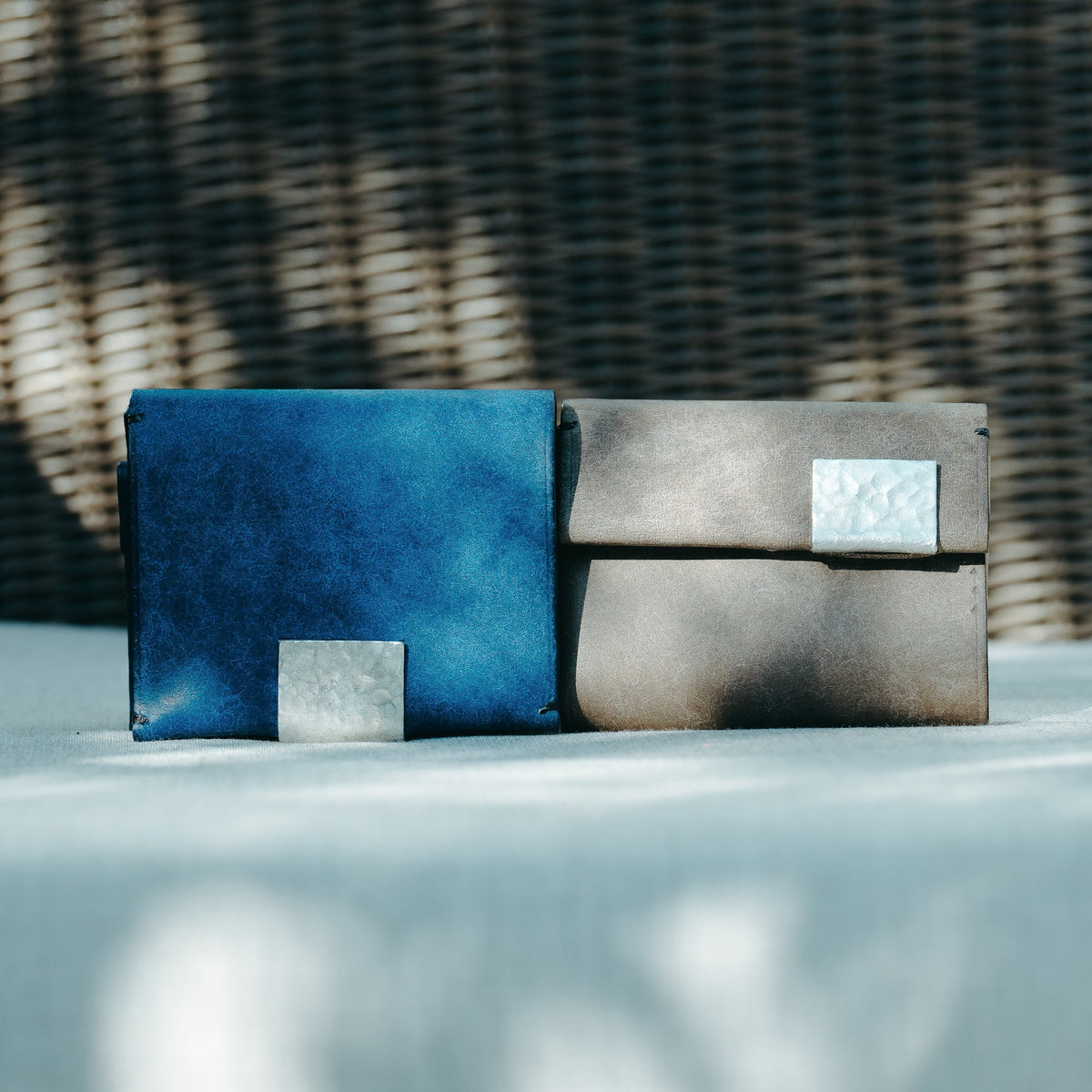
Pick up a Bluno wallet and you will find a small piece of tin on the leather. Its surface has a slightly rough, uneven character. Alongside sewing the leather, we make these metal parts with our own hands.
Today I would like to describe, from a maker’s perspective, how Italian leather and tin become a single wallet. In an earlier article, I introduced tin as a material. Here, I would like to focus on the work that goes into making the finished piece.
Choosing the leather and considering the shape
The leather we mainly use at Bluno is vegetable-tanned leather made in Tuscany, Italy. Because a wallet is handled so often, we place particular importance on how the leather feels and how it changes with use.
Even within a single hide, shade, wrinkles and texture vary from one area to another. As we cut, we select each section with an eye to where that character will appear on the finished wallet. Rather than making every piece look identical, we want to bring out the character already present in the leather.
Vegetable-tanned leather becomes more lustrous and gradually deepens in color as it is handled and used each day. We work with the material while imagining the years ahead, not just how it will look on the day it is finished.
Not all Italian leather has the same texture. If you would like to know more about the leather in a Bluno wallet, we hope you will look not only at where it comes from, but also at how it was tanned and the character of its surface. Understanding these differences makes it a little easier to imagine how a wallet in a photograph will feel and how it might change over time.
Casting the tin parts ourselves
The tin pieces on our wallets are not ready-made fittings that we buy and attach. We make the molds, melt the tin, pour it in, then remove and finish each piece individually.
Even when made in the same mold, the lines on the surface and the way each piece catches the light vary slightly. That is part of what makes tin interesting. We consider the shape and appearance so that the tin sits naturally alongside the leather’s texture without overpowering it.
Making the metal parts ourselves takes time, but when we think a particular shape would suit a leather, we can explore it and refine it with our own hands. Rather than either the leather or the tin taking the leading role, I think it is the two together that make a wallet feel like Bluno.

Cutting, sewing and finishing the leather
Once the parts are ready, we cut the leather to the shape of the wallet and sew it together. At Bluno, we carry out everything ourselves, from cutting and sewing to finishing. Our compact wallet ao, for example, is sewn by hand, one at a time.
Appearance is not the only thing we check as we work. We look at how the wallet moves when opened, how it sits in the hand, and how the parts used repeatedly feel. As we assemble it, we consider whether it will be a pleasure to use as an everyday tool.
Once leather has been cut, it cannot be put back. The smaller the wallet, the more the shape and position of each part affect how the whole thing feels to use. We want to bring out the character of the tin while retaining the softness of the leather. I think we can find that balance because we carry out everything, from making the parts to assembling the wallet, in one atelier.

Gradually becoming complete through use
A finished wallet is not the end of the story. The leather settles into your hand each time you touch it, and the tin also changes in character over time. Even wallets of the same shape and color should, a few years later, have become something unique to each owner.
If stitching comes loose or a fitting develops a problem over years of use, you are welcome to ask us about repairs. Because we make these pieces ourselves, we want to remain part of their lives as you continue to use them.
You can read more about the materials on our leather and tin page, and see the wallet itself on the online shop page for the ao compact wallet. We hope you will take a moment to notice the tin in the photographs, too.
In online photographs, the color of the leather and the texture of the tin can look different depending on the light. If you have a chance to see them at a POPUP or our Chigasaki atelier, please pick one up and look at it from different angles. You may find that the materials feel more immediate than they do in a photograph.